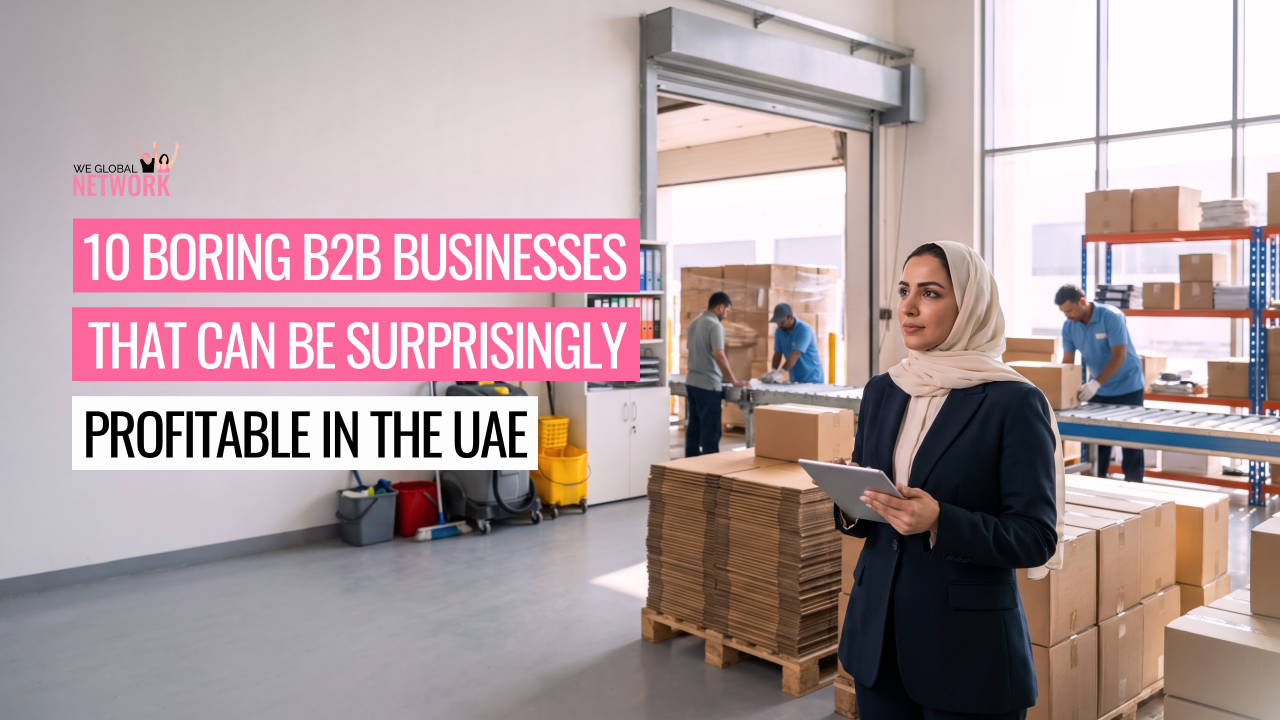
10 Boring B2B Businesses That Can Be Surprisingly Profitable in the UAE
Sep 10, 2026When people think about starting a profitable business in the UAE, the same ideas tend to come up.
Technology. E-commerce. Restaurants. Beauty. Fashion. Digital marketing. AI.
But some businesses making steady money are doing something far less exciting.
They clean offices.
Maintain air-conditioning systems.
Supply uniforms.
Wash commercial linen.
Print signage.
Deliver office consumables.
Rent equipment.
Dispose of confidential documents.
These businesses may never become trendy on social media. But many have something more valuable:
Companies need what they sell repeatedly.
That is what makes certain "boring" B2B businesses worth looking at.
The UAE has a substantial SME economy. In January 2026, the UAE Ministry of Economy and Tourism reported that SMEs accounted for nearly 95% of companies operating in the country and contributed 63% of GDP.
But there is an important distinction.
A necessary service is not automatically a profitable business.
Competition can be intense. Corporate customers can negotiate aggressively. Payments can take time. Staffing and compliance can become complicated. And winning a large contract can actually create cash-flow pressure if you have to fund delivery before the customer pays.
So this isn't a list of "easy businesses to start."
Instead, these are 10 relatively unglamorous B2B business models that can have attractive economics when they are operated well, positioned correctly and built around repeat customers.
What Makes a "Boring" B2B Business Attractive?
Before looking at the ideas, consider why some ordinary businesses can become commercially interesting.
A strong B2B model often has several of these characteristics:
The problem doesn't disappear
Offices still need cleaning.
Buildings still need maintenance.
Employees still need uniforms.
Hotels still need linen cleaned.
Businesses still need signs, packaging and printed material.
These aren't necessarily discretionary purchases.
Customers buy repeatedly
Selling once is useful.
Selling every month, quarter or year is considerably more valuable.
Annual maintenance contracts, scheduled servicing, recurring supply agreements and long-term service contracts can make revenue more predictable.
Customers don't necessarily want to change suppliers
Once a company finds a reliable supplier who delivers correctly, on time and at an acceptable price, switching creates work.
That can create customer retention — provided your service remains good.
The market isn't driven entirely by trends
A fashionable consumer product can become popular very quickly and disappear just as quickly.
A company that reliably cleans 40 offices every night is solving a much less fashionable but more persistent problem.
1. Commercial Cleaning Services
Commercial cleaning isn't new, innovative or particularly glamorous.
That is exactly why it belongs on this list.
Businesses across the UAE require cleaning services for:
- Offices
- Retail outlets
- Clinics
- Warehouses
- Showrooms
- Educational facilities
- Gyms
- Restaurants
- Commercial buildings
The attractive part isn't necessarily a one-off deep-cleaning job.
It's the potential for recurring contracts.
A customer may require cleaning daily, several times per week or under an annual service agreement.
Where the opportunity is
Competing purely as "another cleaning company" can quickly become a price war.
A stronger business may specialise.
For example:
Office cleaning for SMEs
Post-construction cleaning
Industrial cleaning
Retail and showroom cleaning
Clinic cleaning
Move-in/move-out commercial cleaning
High-end commercial facilities
Specialisation can make your sales message much clearer.
What makes this business difficult?
Labour management.
Staffing schedules.
Quality control.
Transportation.
Supervision.
Customer complaints.
Replacement staff.
Margins can disappear quickly if operations aren't tightly controlled.
The business isn't difficult because cleaning itself is complicated.
It's difficult because delivering the same standard across multiple locations every day is an operational challenge.
Recurring revenue potential: HIGH
2. AC and HVAC Maintenance
In many countries, air-conditioning maintenance is seasonal.
In the UAE, cooling systems are central to everyday building operations.
Commercial properties may require:
- Preventive maintenance
- Filter replacement
- Coil cleaning
- Emergency repairs
- System inspections
- Duct-related services
- Planned maintenance
For a B2B operator, the attractive model isn't simply waiting for an AC unit to break.
It is building a portfolio of annual maintenance contracts (AMCs).
Who could buy?
- Offices
- Retail stores
- Restaurants
- Warehouses
- Clinics
- Schools and nurseries
- Property managers
- Building owners
- Facility management companies
Where businesses can differentiate
Reliability.
Fast response times.
Preventive maintenance.
Clear reporting.
Qualified technical staff.
Transparent pricing.
Customers don't want to repeatedly chase a maintenance company while their office is becoming unbearably hot.
A supplier that consistently responds when promised can build a strong reputation.
What makes this business difficult?
Technical capability, staffing, vehicles, equipment, safety, regulatory requirements and emergency service expectations can make the operational setup more complex than many simple service businesses.
Recurring revenue potential: HIGH
3. Uniform and Corporate Workwear Supply
Think about how many UAE businesses have employees wearing uniforms.
Hotels.
Restaurants.
Construction companies.
Security companies.
Facilities-management businesses.
Cleaning companies.
Clinics.
Salons.
Schools.
Logistics companies.
Retail businesses.
Uniforms wear out.
Employees join.
Employees leave.
Branding changes.
New branches open.
Sizes change.
That creates repeat demand.
Don't just sell shirts
The stronger opportunity is to become the company's uniform supplier.
That might include:
- Design
- Fabric sourcing
- Embroidery
- Printing
- Alterations
- Size management
- Reordering
- Delivery
- Replacement stock
A client ordering 500 uniforms doesn't necessarily want to repeat the entire sourcing process six months later.
Make reordering easy and you become more valuable.
Where the margin opportunity exists
Specialisation can help.
For example:
Hospitality uniforms
Construction workwear
Premium corporate uniforms
Healthcare uniforms
Salon and spa uniforms
The more you understand a particular industry's requirements, the less you compete only on price.
Recurring revenue potential: MEDIUM–HIGH
4. Commercial Laundry and Linen Services
A consumer might wash clothes once or twice a week.
Some businesses generate laundry every single day.
Consider:
- Hotels
- Holiday homes
- Restaurants
- Spas
- Salons
- Gyms
- Clinics
- Wellness centres
- Uniformed businesses
These customers may require regular collection, cleaning, processing and delivery.
That creates the possibility of recurring contracts.
The business isn't really about laundry
At scale, it's about logistics.
Can you collect at the agreed time?
Process the volume?
Maintain quality?
Avoid losing items?
Deliver on schedule?
Handle sudden increases in demand?
Track customer inventory?
A commercial customer may tolerate a slightly higher price.
They are much less likely to tolerate:
"Sorry, your linen isn't ready today."
What makes this difficult?
Equipment investment, utilities, logistics, staff, premises, quality control and capacity utilisation can make commercial laundry capital-intensive.
That also creates a barrier to entry compared with many low-cost service businesses.
Recurring revenue potential: HIGH
5. Office Pantry and Workplace Consumables Supply
This may be one of the least exciting businesses on the list.
Which is precisely the point.
Companies continuously consume things.
Coffee.
Tea.
Water.
Tissues.
Cleaning products.
Disposable cups.
Stationery.
Printer supplies.
Pantry products.
Hygiene supplies.
Individually, none of these purchases looks particularly exciting.
Collectively, however, a company may reorder them every month.
The business model
Instead of waiting for customers to remember what they need, create a recurring supply system.
For example:
Monthly office essentials package
or
Managed pantry replenishment
You aren't simply selling coffee and tissues anymore.
You're selling:
"Your office doesn't have to think about this."
Convenience can be a meaningful B2B value proposition.
Where the opportunity becomes stronger
Businesses that can consolidate multiple products into one order may save customers administrative time.
One invoice.
One supplier.
One delivery.
One point of contact.
That's valuable to an office manager or procurement team.
What makes this difficult?
Margins on commodity products can be thin. Logistics, inventory management and aggressive price competition matter.
Volume and repeat customers become important.
Recurring revenue potential: VERY HIGH
6. Signage, Printing and Corporate Branding Production
Digital marketing hasn't eliminated physical branding.
Walk through almost any UAE commercial district and you'll see:
- Shop signs
- Vehicle branding
- Office signage
- Exhibition graphics
- Roll-up banners
- Window graphics
- Packaging
- Business cards
- Brochures
- Event materials
- Corporate gifts
- Safety signage
- Wayfinding signs
Businesses continually require physical branded materials.
Why this can become a strong B2B business
A company may initially approach you for one sign.
But that same customer could later require:
Office branding.
Vehicle graphics.
Event materials.
New branch signage.
Employee cards.
Packaging.
Promotional material.
Instead of treating every order as an isolated printing job, build an account-management relationship.
Where specialisation helps
You could specialise in:
Construction signage
Retail branding
Corporate office branding
Exhibition graphics
Hospitality printing
Real estate marketing materials
Specialisation helps you understand the customer's recurring requirements.
Recurring revenue potential: MEDIUM–HIGH
7. Secure Document Shredding and Records Disposal
Some businesses accumulate documents they cannot simply put in a normal rubbish bin.
These may include:
- Customer information
- Employee records
- Financial documents
- Contracts
- Internal records
- Confidential paperwork
That creates demand for controlled document destruction and disposal.
It's not a business most entrepreneurs dream about starting.
But that's part of what makes "boring businesses" interesting.
The B2B model
Rather than only offering one-off shredding, businesses can potentially provide:
- Scheduled collections
- Secure bins
- On-site or off-site destruction
- Documentation confirming destruction
- Regular service contracts
The customer isn't buying shredded paper.
They're buying secure handling and peace of mind.
Who might require it?
Professional services firms, corporate offices, healthcare-related businesses, educational institutions and other organisations handling sensitive records can potentially require secure disposal solutions.
Requirements around data, records, disposal and specific industries should always be checked carefully before entering this type of business.
Recurring revenue potential: MEDIUM–HIGH
8. Equipment, Tools and Small Plant Rental
Many companies occasionally need equipment they don't want to own.
Why purchase something used only a few times per month?
Depending on the sector, rental businesses can provide:
- Construction equipment
- Small tools
- Access equipment
- Cleaning machines
- Event equipment
- Material-handling equipment
- Generators
- Temporary site equipment
The basic commercial logic is simple:
Buy an asset once. Rent it repeatedly.
But the actual business is more complicated.
What determines profitability?
Utilisation.
A machine sitting unused isn't producing revenue.
So operators need to understand:
- Purchase cost
- Financing cost
- Maintenance
- Repairs
- Transportation
- Insurance
- Storage
- Downtime
- Utilisation rate
- Resale value
Why B2B relationships matter
A contractor who repeatedly rents equipment can be far more valuable than dozens of one-time customers.
That makes account management and relationships important.
What makes this difficult?
Capital requirements can be substantial. Poor asset utilisation can destroy returns.
This is a business where financial modelling matters before purchasing equipment.
Recurring revenue potential: MEDIUM–HIGH
9. Pest Control for Commercial Properties
Pest control is another business people rarely describe as exciting.
Businesses, however, cannot simply ignore pest problems.
Particularly businesses operating in environments such as:
- Restaurants
- Food facilities
- Warehouses
- Hotels
- Offices
- Retail premises
- Property portfolios
The recurring opportunity comes from scheduled preventive service, rather than only emergency call-outs.
What customers really buy
They aren't buying someone spraying chemicals.
They are buying:
Prevention.
Reliability.
Documentation.
Response when something goes wrong.
For certain sectors, maintaining appropriate pest-management standards can be operationally important.
What makes this difficult?
Licensing, chemical handling, safety requirements, trained personnel and applicable municipal/regulatory requirements mean this is not something to enter casually.
Businesses should verify current requirements with the relevant authority in their emirate before investing.
Recurring revenue potential: HIGH
10. Specialised Maintenance and Annual Maintenance Contracts
This is intentionally broad because there are many niches within commercial maintenance.
Companies and properties continuously require people to maintain things.
Examples might include:
- Doors
- Glass
- Plumbing
- Electrical systems
- Joinery
- Kitchen equipment
- Pumps
- Lighting
- Flooring
- Office furniture
- Commercial equipment
- Building systems
A specialist who becomes known for solving one particular problem reliably can build an attractive B2B operation.
The key is specialisation
"General maintenance company" puts you against thousands of competitors.
But:
Commercial kitchen equipment maintenance
or
Retail glass and door maintenance
or
Office furniture repair and maintenance
is much clearer.
Customers immediately understand when they need you.
Move from reactive to recurring
The strongest transition can be:
Call us when something breaks
to:
We maintain this for you throughout the year.
That's the difference between unpredictable jobs and recurring revenue.
Recurring revenue potential: HIGH
Quick Comparison: Which B2B Businesses Have the Strongest Recurring Potential?
| Business | Setup Complexity | Recurring Revenue Potential | Capital Requirement* | Operational Complexity |
|---|---|---|---|---|
| Commercial Cleaning | Medium | High | Low–Medium | High |
| HVAC Maintenance | High | High | Medium | High |
| Uniform Supply | Medium | Medium–High | Medium | Medium |
| Commercial Laundry | High | High | High | High |
| Office Consumables | Medium | Very High | Medium | Medium |
| Signage & Printing | Medium–High | Medium–High | Medium–High | Medium |
| Document Shredding | Medium | Medium–High | Medium | Medium |
| Equipment Rental | High | Medium–High | High | High |
| Pest Control | High | High | Medium | High |
| Specialised Maintenance | Medium–High | High | Medium | High |
NOTE : These are broad comparisons only. Actual investment requirements depend heavily on the business model, activity, emirate, equipment, staffing and whether operations are owned, leased or outsourced.
Why "Boring" Doesn't Mean Easy
This is perhaps the most important part of this article.
A boring business isn't automatically a good business.
And recurring demand doesn't guarantee recurring profit.
Several things can go wrong.
1. You compete entirely on price
If your only message is:
"We're cheaper."
another supplier can always become cheaper.
Strong B2B companies find other reasons to win:
- Reliability
- Response time
- Specialisation
- Reporting
- Convenience
- Quality
- Capacity
- Compliance
- Account management
2. You win contracts you can't afford to deliver
Imagine winning an AED 500,000 corporate contract.
Sounds fantastic.
But what if you need AED 200,000 to mobilise staff, equipment and materials — and the customer pays considerably later?
Your profitable new contract may create an immediate cash-flow problem.
Revenue growth requires working capital.
Before accepting a large contract, understand exactly what you need to spend before the first customer payment arrives.
3. One customer becomes too important
A recurring AED 50,000-per-month customer feels wonderful.
Until that customer represents 60% of your revenue.
Customer concentration creates risk.
Build recurring contracts, but continue diversifying.
4. You underestimate operational management
Many businesses on this list aren't marketing businesses.
They're operations businesses.
The company wins because:
People arrive.
Products arrive.
Machines work.
Schedules are followed.
Problems are resolved.
Quality remains consistent.
That sounds simple until you're coordinating 70 employees across 25 customer locations.
4. You underestimate operational management
Many businesses on this list aren't marketing businesses.
They're operations businesses.
The company wins because:
People arrive.
Products arrive.
Machines work.
Schedules are followed.
Problems are resolved.
Quality remains consistent.
That sounds simple until you're coordinating 70 employees across 25 customer locations.
5. You don't understand your margins
Winning more contracts isn't necessarily good if every contract is poorly priced.
Know the full cost of serving each customer.
That can include:
Labour.
Transport.
Materials.
Equipment.
Supervision.
Insurance.
Administration.
Rework.
Credit period.
Overheads.
The biggest customer isn't necessarily the most profitable customer.
How Do B2B SMEs Actually Win Larger Customers in the UAE?
This is where the conversation becomes more interesting.
You can build a brilliant service and still struggle if nobody knows you exist.
B2B growth often requires a combination of:
Direct business development
Identify companies that genuinely need your service.
Don't send the same generic company profile to 5,000 businesses.
Build a target list.
Referrals
Strong suppliers get recommended.
Ask satisfied customers for introductions.
Procurement and vendor registration
Larger organisations may require suppliers to complete vendor-registration and procurement processes before they can receive work.
This is why documentation, licences, insurance, financial records, certifications where relevant and a professional company profile matter.
The UAE is actively creating procurement opportunities for SMEs. In January 2026, the Ministry of Economy and Tourism said the National Forum for SMEs – Government Procurement 2026 made AED 2.445 billion in government contracts and tenders available through participating federal and local entities and national companies.
That doesn't mean every SME automatically qualifies for government work.
It demonstrates something more important:
Procurement readiness matters.
Strategic networking
The person you meet today may not need your service.
But they may know the Facilities Manager, Procurement Manager, HR Director, Operations Head or business owner who does.
For B2B businesses, networking isn't simply about exchanging business cards.
It's about becoming known within the right business circles.
Partnerships
Sometimes the easiest route to a corporate client isn't directly through the corporate.
A smaller business may become a subcontractor or specialist supplier to:
- Facilities-management companies
- Main contractors
- Event companies
- Property managers
- Hospitality groups
- Larger service providers
One partnership can create access to multiple customers.
Should You Start One of These Businesses From Scratch — or Buy One?
This is another question worth considering.
For operational B2B businesses, buying an existing company can sometimes provide immediate access to:
- Existing customers
- Contracts
- Employees
- Equipment
- Supplier relationships
- Vehicles
- Operating history
- Systems
But don't buy revenue without understanding what's behind it.
If you're considering acquiring an existing B2B business, investigate:
Customer concentration
What percentage of revenue comes from the top five customers?
Contract transferability
Will existing contracts remain after ownership changes?
Receivables
How much money is outstanding — and how old is it?
Employee liabilities
Understand the workforce and associated obligations.
Equipment
What actually belongs to the company?
What is leased?
What needs replacement?
Margins
Don't only review revenue.
Understand gross and net profitability by customer or service line where possible.
Owner dependency
Does the business function independently?
Or does every important customer relationship depend personally on the existing owner?
Compliance
Verify licences, approvals, tax position, contracts and other obligations through appropriate professional due diligence.
What Should You Look for Before Starting a "Boring" B2B Business?
Don't choose a business simply because someone says it's profitable.
Ask these questions first.
Is demand recurring?
How difficult is it to win the first 10 customers?
How long do customers take to pay?
How much working capital will I need?
How competitive is pricing?
What licences and approvals are required?
How dependent is the business on labour?
Can I build contracts rather than one-off jobs?
What prevents customers from switching suppliers?
Can the business operate without me personally managing every transaction?
Can the model scale without destroying service quality?
Those questions tell you much more than:
"How big is the market?"
The Best B2B Businesses Often Solve Problems Nobody Wants to Think About
This is the common thread running through almost every business on this list.
An office manager doesn't want to spend Tuesday morning wondering why the tissues haven't arrived.
A facilities manager doesn't want to chase an AC contractor.
A hotel doesn't want to discover its linen delivery is late.
A construction company doesn't want its rented equipment unavailable when the team needs it.
A restaurant doesn't want pest-control problems.
A procurement manager doesn't want to repeatedly search for a reliable uniform supplier.
The strongest B2B businesses remove these problems quietly.
And once customers trust them, they often prefer to keep the relationship.
That's where "boring" becomes commercially interesting.
From Small Supplier to Serious B2B Business
There is also a significant difference between being:
someone who provides a service
and
a company capable of servicing serious corporate customers.
As the business grows, founders need to think about:
- Professional proposals
- Contracts
- Insurance
- Financial controls
- Quality processes
- Reporting
- Customer service
- Account management
- Staff training
- Procurement requirements
- Cash-flow forecasting
- CRM systems
- Operational capacity
This is where many SMEs hit their next growth barrier.
They know how to deliver the service.
But they haven't yet built the business infrastructure around the service.
That infrastructure is what allows a small supplier to become a credible corporate vendor.
How WE Global Network Helps SMEs Build the Right Business Connections
At WE Global Network, one of our core objectives is creating meaningful connections between entrepreneurs, SME owners, established businesses and the wider corporate ecosystem.
For a B2B founder, visibility within the right business network can be just as important as visibility on social media.
Through our networking formats, curated business conversations, events, corporate interactions and wider ecosystem, we create opportunities for serious business owners to:
- Build relationships with other SME owners
- Increase visibility for their businesses
- Meet potential clients and collaborators
- Understand how larger organisations think
- Develop corporate connections
- Explore partnerships and business opportunities
- Become part of a wider UAE business ecosystem
If you're building a serious B2B business in the UAE and want to grow your network beyond simply collecting contacts, explore WE Global Network membership and upcoming business events.
Because sometimes the next contract doesn't start with an advertisement.
It starts with the right conversation.
Final Thoughts
Some of the UAE's most interesting business opportunities may never look particularly exciting on Instagram.
That's not necessarily a disadvantage.
Businesses will continue to need their offices cleaned.
Their AC systems maintained.
Their employees uniformed.
Their linen processed.
Their workplaces supplied.
Their signage produced.
Their equipment rented.
Their facilities maintained.
The opportunity isn't simply in identifying something businesses need.
It's in building a company that can provide it reliably, repeatedly and profitably.
So if you're evaluating your next business opportunity, don't only ask:
"What's trending?"
Ask:
"What problem will businesses still be paying someone to solve five or ten years from now?"
The answer may be far more boring.
And potentially far more interesting as a business.
Disclaimer
This article is for general educational and informational purposes only. It does not constitute financial, investment, legal, tax or business setup advice. Licensing, regulatory, staffing, safety and approval requirements differ by business activity and emirate. Before starting or acquiring a business in the UAE, verify current requirements with the relevant UAE authorities and obtain appropriate professional advice.
Join WE Global Network
WE Global Network is a premium, women-only business community for established and scaling entrepreneurs, founders and CEOs. Through curated networking events, international delegations and strategic collaborations, we connect you with the people, opportunities and insights to grow across markets. If you’re leading a serious, growth-focused business and want to be in a room of women who think as big as you do, this is your circle.