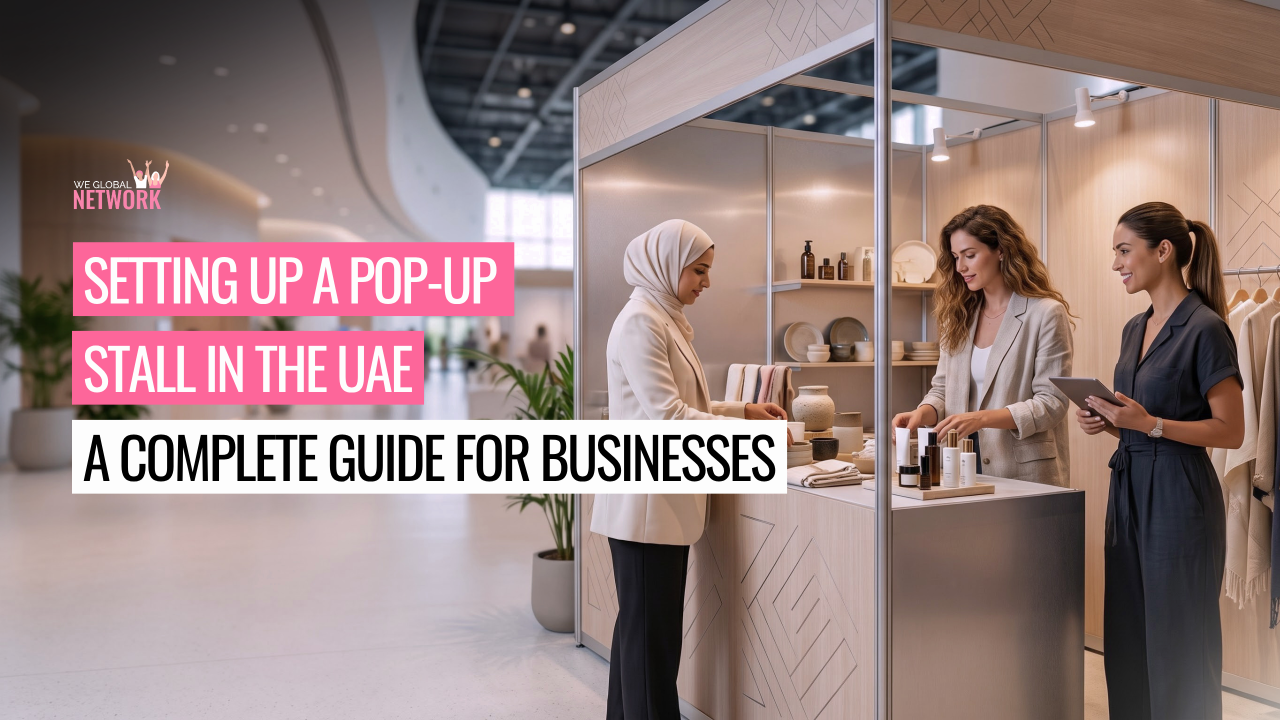
Setting Up a Pop-Up Stall in the UAE: A Complete Guide for Businesses
Sep 04, 2026Pop-up stalls are everywhere in the UAE.
Weekend markets. Business conferences. Community events. Exhibitions. Festivals. Networking events. School fairs. Corporate gatherings. Seasonal markets.
For a small business, participating in one can look straightforward:
Pay for a stall. Set up your products. Make some sales. Go home.
But if that's the only objective, you may be missing most of the opportunity.
A well-planned pop-up stall can help your business:
- Generate immediate sales
- Introduce your brand to hundreds of new people
- Collect qualified leads
- Test new products
- Understand customer behaviour
- Build a marketing database
- Create social media content
- Meet potential collaborators
- Connect with corporate buyers
- Generate future enquiries
- Get direct customer feedback
And sometimes, the biggest business opportunity from an event happens weeks or months after the stall has been packed away.
The key is knowing what you want from the event before you book it.
This guide explains what UAE businesses should consider before participating in a pop-up stall, what to expect on the day, how B2B and B2C strategies should differ, and what to do after the event to generate a better return from your investment.
First: Why Are You Taking the Stall?
This question should come before:
"How much does the stall cost?"
Ask yourself:
What would make this event successful for my business?
There are several possible answers.
Objective 1: Direct Sales
This makes sense for businesses selling:
- Fashion
- Jewellery
- Beauty products
- Food
- Gifts
- Accessories
- Home products
- Art
- Children's products
- Handmade goods
Your primary KPI may be revenue generated during the event.
Objective 2: Lead Generation
This is more relevant for businesses such as:
- Consultants
- Agencies
- Coaches
- Business service providers
- Interior designers
- Financial professionals
- Corporate gifting companies
- Training companies
- Technology businesses
You may not sell anything at the stall.
But 20 qualified leads could be considerably more valuable than AED 5,000 in same-day sales.
Objective 3: Brand Awareness
Perhaps you're launching a new brand.
Your objective might simply be to introduce it to the right audience.
Then you may measure:
- Visitors to the stall
- QR scans
- Social followers
- Samples distributed
- Email sign-ups
- Content generated
- Conversations
Objective 4: Product Testing
Events are excellent places to observe real customer behaviour.
You can learn:
- Which product people pick up first
- Which colours attract attention
- Which price creates hesitation
- Which questions are repeatedly asked
- Which products customers compare
- What people love but don't purchase
That information can be enormously valuable.
Objective 5: Business Development
For a B2B company, your goal may be completely different.
You may want to meet:
- Corporate decision-makers
- Procurement professionals
- HR leaders
- Potential referral partners
- Distributors
- Retailers
- Investors
- Other business owners
One strong introduction may justify the entire cost of participating.
Before Booking: Evaluate the Event Properly
Not every busy event is a good event for your business.
An organiser may tell you:
"We're expecting 5,000 visitors."
That sounds impressive.
But the better question is:
Who are those 5,000 people?
An event with 500 highly relevant attendees may produce far better results than an event with 5,000 people who aren't your customers.
Before paying, ask the organiser for as much information as possible about:
- Expected attendance
- Audience demographics
- Previous editions
- Venue
- Event timings
- Other exhibitors
- Event marketing
- Stall location
- Number of similar vendors
- Parking and accessibility
- Whether visitors pay to enter
- Whether food is included
- Whether the event is B2B or B2C
- Expected corporate participation
- What is included in the stall fee
If it's a recurring event, look at photographs and videos from previous editions.
Don't only look at how beautiful the event appeared.
Look at the crowd.
Were people actually interacting with exhibitors?
Understand the Full Cost — Not Just the Stall Fee
Suppose the stall costs AED 1,000.
Your actual investment may be much higher.
You may also need:
- Display stands
- Tablecloths
- Banners
- Printing
- Product samples
- Packaging
- Staff
- Transportation
- Parking
- Card-payment facilities
- Electricity
- Wi-Fi
- Furniture
- Lighting
- Giveaways
- Event-only offers
- Additional inventory
If your total investment becomes AED 3,500, evaluate the event against AED 3,500, not the AED 1,000 booking fee.
For product businesses, also calculate your gross margin.
AED 5,000 in event sales isn't AED 5,000 in profit.
Check Licences, Permits and Venue Requirements
Dubai Department of Economy and Tourism's events and activations guidance
Don't assume that having a trade licence automatically allows you to sell or promote products at every event.
Requirements can depend on:
- Emirate
- Venue
- Event
- Business activity
- Products being sold
- Whether you're conducting a promotion
- Whether food is involved
Ask the organiser exactly what documentation they require from vendors and which approvals are being handled by the organiser versus the exhibitor.
For Dubai events, businesses should check current requirements with the relevant authorities and event organiser before participating.
Food businesses should be particularly careful because additional food-safety requirements and approvals may apply.
Never leave this until the day before the event.
The Biggest Stall Mistake: Trying to Display Everything
Your stall isn't your warehouse.
Visitors should be able to understand your business within a few seconds.
A crowded table filled with every product you've ever created often makes buying more difficult.
Instead, think of your stall as a physical landing page.
It needs:
One clear message
What do you sell or solve?
One visual focal point
What should people notice first?
One primary action
What should they do next?
Buy?
Scan?
Register?
Book?
Try?
Ask?
If visitors can't understand the stall while walking past it, simplify it.
Design Your Stall for People Who Don't Know You
Your existing customers already understand your business.
Most event visitors don't.
Avoid assuming people know:
- Your brand
- What you sell
- Your price range
- Who your service is for
- Why you're different
Your signage should answer those questions quickly.
Instead of only displaying:
XYZ CONSULTING
Consider:
Helping UAE SMEs Build HR Systems Without a Full-Time HR Team
The second message gives someone a reason to stop.
Your Stall Needs a Hook
People at events see dozens of exhibitors.
Give them a reason to engage.
This doesn't have to mean shouting:
"WIN A FREE PRIZE!"
A hook could be:
- Free product trial
- Live demonstration
- Quick assessment
- Personalised recommendation
- Product tasting
- Mini consultation
- Quiz
- Interactive game
- Photo opportunity
- Event-exclusive bundle
- Useful downloadable resource
The best hook connects directly to what your business sells.
Don't Just Collect Business Cards. Build a Database.
This is where many businesses waste the biggest opportunity.
Someone visits.
You speak.
They say:
"Very interesting."
They take your brochure.
You never hear from them again.
Instead, create a simple system for capturing information.
At minimum, consider collecting:
- Name
- Phone/WhatsApp where appropriate
- Company
- Area of interest
For B2B businesses, you may also want:
- Job title
- Company size
- Requirement
- Expected timeline
Don't collect information you have no intention of using.
And make it clear what people are signing up for.
Creative Ways to Collect Leads at Your Stall
Simply displaying:
"Scan here to join our mailing list"
may not generate much enthusiasm.
Give visitors a genuine reason to participate.
1. Run a Useful Assessment
For example:
"How Ready Is Your Business to Work With Corporates?"
Visitors answer five questions.
They receive a score or checklist.
You receive a qualified lead.
2. Offer a Useful Download
Examples:
10-Point SME Finance Checklist
Dubai Home Buying Guide
Corporate Gifting Catalogue
Instagram Content Planner
Hiring Checklist for UAE SMEs
The resource should connect directly to your business.
3. Event-Only Consultation
Instead of discounting your service:
Scan to book a complimentary 15-minute assessment.
This works particularly well for B2B businesses.
4. Product Recommendation Quiz
Beauty brand?
Find your ideal skincare routine.
Gift company?
Find the right gift for your budget.
Food company?
Discover your flavour profile.
The interaction becomes both marketing and customer research.
5. Competition With Purpose
Giveaways can generate leads, but be careful.
If the prize is unrelated to your business, you'll attract people who only want the prize.
A business consultant giving away an iPhone may collect hundreds of useless contacts.
A consultant giving away a strategy session attracts fewer people — but potentially much better leads.
Quality matters more than quantity.
Also check applicable event and promotional requirements before running competitions, raffles or prize promotions.
QR Codes: Don't Send Everyone to Your Homepage
This is another common mistake.
Someone scans the QR code.
They land on your homepage.
Then what?
Create an event-specific page.
For example:
yourbusiness.ae/eventname
The page could contain:
- Short introduction
- Event offer
- Product catalogue
- Booking link
- Lead form
- WhatsApp button
- Downloadable resource
- Social links
Now you can also measure how many people visited the page.
B2C Stall Strategy: Focus on Experience and Conversion
For consumer businesses, the stall needs to make purchasing easy.
Your objectives might include:
Stop
What makes someone notice you?
Touch/Try
Can they experience the product?
Understand
Is the benefit immediately clear?
Buy
Can they purchase quickly?
Return
Can you capture the relationship for future sales?
What B2C Businesses Should Prepare
Clear Pricing
Don't make customers repeatedly ask:
"How much is this?"
Visible pricing removes friction.
Easy Payments
Prepare appropriate payment methods in advance.
Test them before the event.
Bundles
Instead of automatically discounting individual products, consider:
Buy 2 / Buy 3 bundles
Event gift set
Starter bundle
Family pack
Bundles can increase average transaction value without reducing every product's price.
Samples
For appropriate products, samples can convert hesitant buyers.
Packaging
Remember customers may continue walking around the event.
Make purchases easy to carry.
Stock Planning
Bring enough stock, but don't blindly overstock.
If possible, review previous event performance and expected attendance.
B2B Stall Strategy: Stop Thinking Like a Retailer
A B2B business shouldn't necessarily judge its stall by how much money it collects that day.
Imagine you're a corporate gifting company.
You meet a procurement manager from a large organisation.
They don't buy anything.
Three months later, they place an AED 75,000 order.
Was the event unsuccessful?
Of course not.
Your metrics were simply different.
What a B2B Stall Should Do
Clearly State Who You Help
Instead of:
"Business Solutions for Everyone"
try:
"Corporate Gifting for UAE Companies — From 50 to 5,000 Employees"
Specificity helps the right people identify themselves.
Display Proof
Show:
- Client logos where permission exists
- Case studies
- Previous projects
- Before-and-after examples
- Testimonials
- Certifications
- Portfolio work
Corporate buyers want confidence that you can deliver.
Have a Corporate Capability Deck Ready
Not necessarily printed.
A QR code can lead directly to:
Download Our Corporate Profile
or:
View Our Corporate Portfolio
Qualify the Conversation
Ask:
"What type of organisation are you with?"
"Do you currently use an external provider for this?"
"When do you normally plan this?"
"Who usually manages this internally?"
You're not interrogating them.
You're understanding whether there is a genuine opportunity.
Your Team Matters More Than Your Stall Design
You can spend AED 10,000 designing a beautiful stall.
If the person representing your company spends the day sitting behind the table looking at their phone, much of that investment is wasted.
Brief your team before the event.
They should know:
- The objective
- Key message
- Main offer
- Pricing
- Frequently asked questions
- Lead-capture process
- How to qualify visitors
- What not to promise
- Who handles important enquiries
And please:
Don't eat lunch at the front of the stall while potential customers are walking past.
Arrange breaks.
Don't Judge the Event During the First Hour
Some events start slowly.
Others become busy later.
B2B events may generate fewer conversations but higher-quality ones.
Stay engaged.
Observe.
Test different approaches.
If nobody is stopping, change something.
Move your hero product.
Change your opening question.
Simplify your signage.
Stand in front rather than behind the table where appropriate.
An event is live customer research.
Use it.
Create Content While You're There
Your stall is also a temporary content studio.
Capture:
- Setup timelapse
- Product demonstrations
- Customer reactions where permission is obtained
- Founder videos
- Team moments
- Event atmosphere
- FAQs people ask
- Behind-the-scenes content
- Product close-ups
- Business conversations where appropriate
One event can potentially generate weeks of content.
Think about this before the event so someone is responsible for capturing it.
Network Beyond Your Own Stall
Don't spend the entire event waiting for customers to come to you.
Meet other exhibitors.
Some may become:
- Referral partners
- Suppliers
- Collaborators
- Customers
- Distributors
- Corporate connections
If you have multiple team members, rotate.
One person manages the stall.
Another explores the room and builds relationships.
This is particularly important for B2B events.
What to Do Immediately After the Event
This is where the second half of your ROI begins.
Don't wait two weeks.
People forget quickly.
Within 24–72 hours, organise your leads.
Segment Your Leads Before Following Up
Don't send everyone the same message.
Separate them into groups.
Hot
Clear requirement and potential buying intent.
Follow up personally and quickly.
Warm
Interested but no immediate requirement.
Send relevant information and continue nurturing.
Long-Term
Good relationship but no current opportunity.
Add them to an appropriate long-term follow-up process where consent permits.
B2C Customers
Consider sending:
- Thank-you message
- Product-care information
- Complementary product recommendation
- Future offer
- New launch information
The objective is to continue the relationship, not immediately bombard people with sales messages.
Your Follow-Up Should Reference the Conversation
Avoid:
"Hi, we met at XYZ event. Please find attached our company profile."
Instead:
It was good meeting you at XYZ. You mentioned that your team is reviewing employee gifting options for December. I'm sharing the corporate catalogue we discussed, particularly the options suitable for teams of 200+.
Now the follow-up feels relevant.
Measure the Event Properly
Don't simply ask:
"How much did we sell?"
Create an event scorecard.
B2C Metrics
Track:
- Stall investment
- Revenue
- Number of transactions
- Average order value
- Units sold
- Leads collected
- New followers
- Repeat purchases generated later
B2B Metrics
Track:
- Qualified conversations
- Decision-makers met
- Meetings booked
- Proposals requested
- Partnership opportunities
- Corporate leads
- Leads converted within 30/60/90 days
- Revenue eventually attributed to the event
Only then can you decide whether the event was worth repeating.
What NOT to Expect From Every Pop-Up Event
A stall isn't a guaranteed sales machine.
You may have an excellent product and still experience a quiet event.
Why?
Perhaps:
- Wrong audience
- Poor footfall
- Bad stall location
- Too many similar vendors
- Weak event marketing
- Wrong pricing
- Weather affected attendance
- Visitors weren't in buying mode
- Your messaging wasn't clear
Don't decide:
"Pop-ups don't work for my business"
based on one event.
Instead ask:
What did this event teach us?
Then decide whether to improve the strategy, choose a different event, or stop investing in that particular channel.
A Simple ROI Example
Suppose your total event investment is:
Stall: AED 1,500
Display/printing: AED 500
Staff/transport: AED 500
Samples/giveaways: AED 500
Total: AED 3,000
You generate:
AED 2,000 in immediate sales.
At first glance:
"We lost money."
But suppose you also collected 80 relevant leads.
Within the next 60 days:
- 10 purchase online
- 3 become repeat customers
- 1 introduces you to a corporate buyer
- That corporate buyer places an AED 15,000 order
Now the economics look completely different.
This is why measuring only same-day sales can seriously underestimate an event's value.
Before Your Next UAE Pop-Up: Use This Checklist
Before Booking
☐ Define the primary objective
☐ Understand the audience
☐ Ask for expected footfall
☐ Research previous editions
☐ Check competing vendors
☐ Calculate total cost
☐ Confirm licences/approvals
☐ Understand what's included
Before the Event
☐ Prepare signage
☐ Create a clear stall hook
☐ Set up lead capture
☐ Create QR landing page
☐ Prepare payment methods
☐ Brief staff
☐ Plan inventory
☐ Prepare content plan
☐ Create B2B capability material if relevant
☐ Set measurable targets
During the Event
☐ Engage visitors
☐ Capture leads
☐ Qualify conversations
☐ Track sales
☐ Observe customer behaviour
☐ Capture content
☐ Network with exhibitors
☐ Record important notes against leads
After the Event
☐ Segment leads
☐ Follow up within 24–72 hours
☐ Book relevant meetings
☐ Add consenting contacts to your database
☐ Publish event content
☐ Track 30/60/90-day conversions
☐ Calculate full ROI
☐ Document lessons for the next event
Pop-Up Stalls Should Be Part of Your Marketing Strategy — Not Separate From It
The biggest shift for business owners is to stop thinking:
We're taking a stall at an event.
And start thinking:
We're running a live marketing campaign at an event.
Before the event, you promote your participation.
During the event, you generate awareness, conversations, sales, leads and content.
After the event, you nurture those relationships.
That turns one day of exhibition space into potentially months of business development.
Showcase Your Business Through WE Global Network
At WE Global Network, we regularly create opportunities for businesses to gain visibility within our wider entrepreneurial and professional ecosystem.
Depending on the event and format, selected businesses may have opportunities to showcase themselves through display stalls and other brand visibility opportunities at WE Global Network events and partner initiatives.
These opportunities can be particularly useful for businesses that want to:
- Introduce products to a relevant audience
- Build brand awareness
- Meet entrepreneurs and business owners
- Generate leads
- Explore collaborations
- Create corporate connections
- Test new products or offers
Our focus is not simply on putting a table in a room.
We encourage businesses to think about how the opportunity can support their wider sales, marketing and relationship-building strategy.
If you're interested in showcasing your business at an upcoming WE Global Network event, explore our upcoming events and display opportunities or speak to the WE Global team about formats relevant to your business.
Final Thoughts
A pop-up stall can be a sales channel.
But it can also be much more.
It can be:
A customer research exercise.
A lead-generation campaign.
A brand-awareness campaign.
A content opportunity.
A business-development exercise.
A relationship-building platform.
The businesses that get the greatest value from events are usually not the ones with the biggest stall.
They're the ones that arrive knowing:
Who do we want to meet?
What do we want them to remember?
What action do we want them to take?
And what are we going to do with that relationship after the event ends?
Answer those questions before you book your next stall.
Your return from the event may look very different.
Join WE Global Network
WE Global Network is a premium, women-only business community for established and scaling entrepreneurs, founders and CEOs. Through curated networking events, international delegations and strategic collaborations, we connect you with the people, opportunities and insights to grow across markets. If you’re leading a serious, growth-focused business and want to be in a room of women who think as big as you do, this is your circle.